
AI is set to completely change the way we work, yet most jobs remain largely unchanged since ChatGPT was released. Why is that? It is a combination of our psychological resistance to change, cognitive overload because of the incredible pace of innovation, and the fear of an unknown future. This combination paralyses us into a state of passivity. This has happened before. Studying past technological paradigm shifts provides the framework to break this paralysis and can help us to reimagine our work.
While the discussions about when Artificial General Intelligence (AGI) will arrive and what it will mean for society are the top news stories (just look at Anthropic’s Mythos stories right now), the technical reality is that the way the APIs of the models work is structurally the same as those of a couple years ago. Most of the progress that we have gone through and that makes Large Language Models (LLMs) more useful are application-based breakthroughs, not core intelligence breakthroughs (e.g. Claude Code, Openclaw). The core intelligence improving is still a very important lever of progress, but extracting the currently underutilised intelligence capabilities is where the groundbreaking innovations will happen.
If we were to stop all technical progress today, then we would already have all the tools we need to completely reimagine the way we work. This concept is called “technological overhang”, and the overhang present in the current models is a very important one to work through. We generally overestimate what is possible in 1 year, but we underestimate what is possible in 5-10 years. And that is even more the case in AI than before. This overhang is not a novel thing. What can we learn from the previous times? This is the domain of technological paradigm shifts.
The way a technological paradigm shift plays out is similar across paradigm shifts (its high-level process). The difference is the specific technology that is causing the shift. In these shifts there are different orders (or layers) of change. The first order is the substitution layer, the second order is the redesign layer, where the work processes completely change and the final and third layer is the emergence layer where work that was never possible before the new paradigm is introduced.1
Before working through these layers, we need to highlight that the different layers often overlap while they are playing out. There is no clear single switchover moment from one layer to the next. During paradigm shifts there often is a period when the old paradigm and the new paradigm struggle for dominance. This is a messy period and comes with socio-economic unrest. My feeling is that we are starting to enter one of these turning points.
The invention of the Gutenberg Printing Press in the 15th Century is a good example of the first layer (the substitution principle). It automated the work that monks were doing. The Gutenberg Bibles, as they were called, were even designed to mimic handwritten manuscripts, using “handwritten” fonts. This is the principle of automating human work in the way it used to be done. The modern day AI analog here is quite obvious where AI is already substituting a lot of basic work. From writing boilerplate code to summarising large texts. This is the layer in which everyone quickly sees the application and base value of a new technology.


It is a straightforward application if the technology can directly automate an existing work process. It is harder to to find a way to rethink a system in a way that was not possible before the new technology existed. The invention of electricity is a good analogue on how the second (redesign) and third (emergence) layers play out.
In the 1870s Thomas Edison & Joseph Swan independently showcased the potential of electricity with the invention of the lightbulb. This was followed in 1881 by the introduction of the first electricity generating stations in New York & London. Within a year, electricity was being sold as a commodity.
Factories at that time were powered by a massive steam engine, which in turn powered a central drive shaft that ran through the factory floor. That shaft is connected to multiple machines by belts and gears. This drove automated hammers, presses, looms and other machinery. If only one of these smaller machines needed to be used, the whole steam engine had to be powered on and all the machines connected to the central drive shaft had to run. Besides this limitation, there were many other smaller maintenance and fire-related problems with this system. This all made it sub-optimal, but it was the only way to automate a lot of work back then.
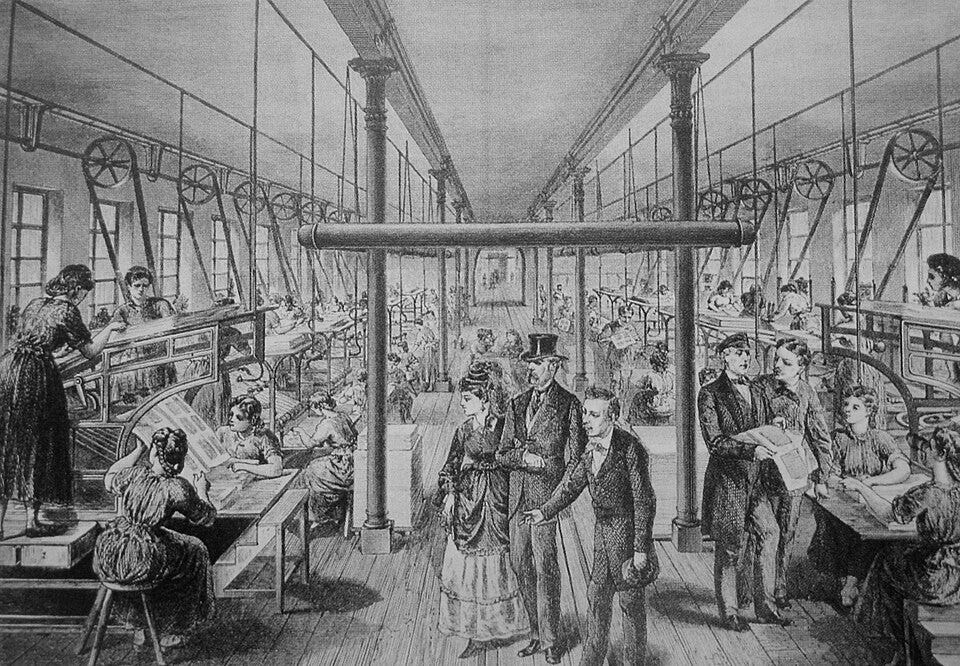

We would expect the factories of the day to quickly adopt the new technology of the day (electricity) with its clear advantages. But 10 years after the electricity generating stations were introduced, only about 5% of American factories that needed a mechanical drive used electric motors instead of steam-powered engines.
This was because they used the substitution method. A number of factory owners had replaced the massive steam engine with an equally massive electric motor, but the savings were minimal. It was a significant investment and was not really paying off. This was because the technology was not being used in the way it was most useful.
The electric motor did not need to power a massive central shaft. Electricity made it possible to deliver the mechanical power exactly where it was needed. Small electric motors were significantly more efficient than small steam engines. As a result, a factory could hypothetically have multiple smaller electric motors instead of one massive one.
This meant that every workbench could have its own electric motor. It resulted in a factory floor where the workers could actually set the pace, not the massive steam engine. It required the factory-owner to rethink the layout of the workshop, because the organising principle of the work became the production process and the people doing it instead of the (steam-powered) engine.
The pay-off did not come from simply switching out the steam engine with an electric motor while keeping the way of working the same. Workers became more autonomous and more flexible. This resulted in a different way people were recruited, trained and even the way they were paid changed. This meant that factory owners who had invested in a factory floor (and business model) that was working fine enough had no incentive to change. Even when different parts of the factory broke down, it was cheaper to fix them rather than to completely redesign the workshop.
Around the 1920s there was a perfect storm in which it (finally) all came together. Electricity became cheaper and more reliable. Average wages for American workers increased massively through a combination of factors, and the first lessons from electrification allowed new factory owners to rethink the processes when designing the factory floor.
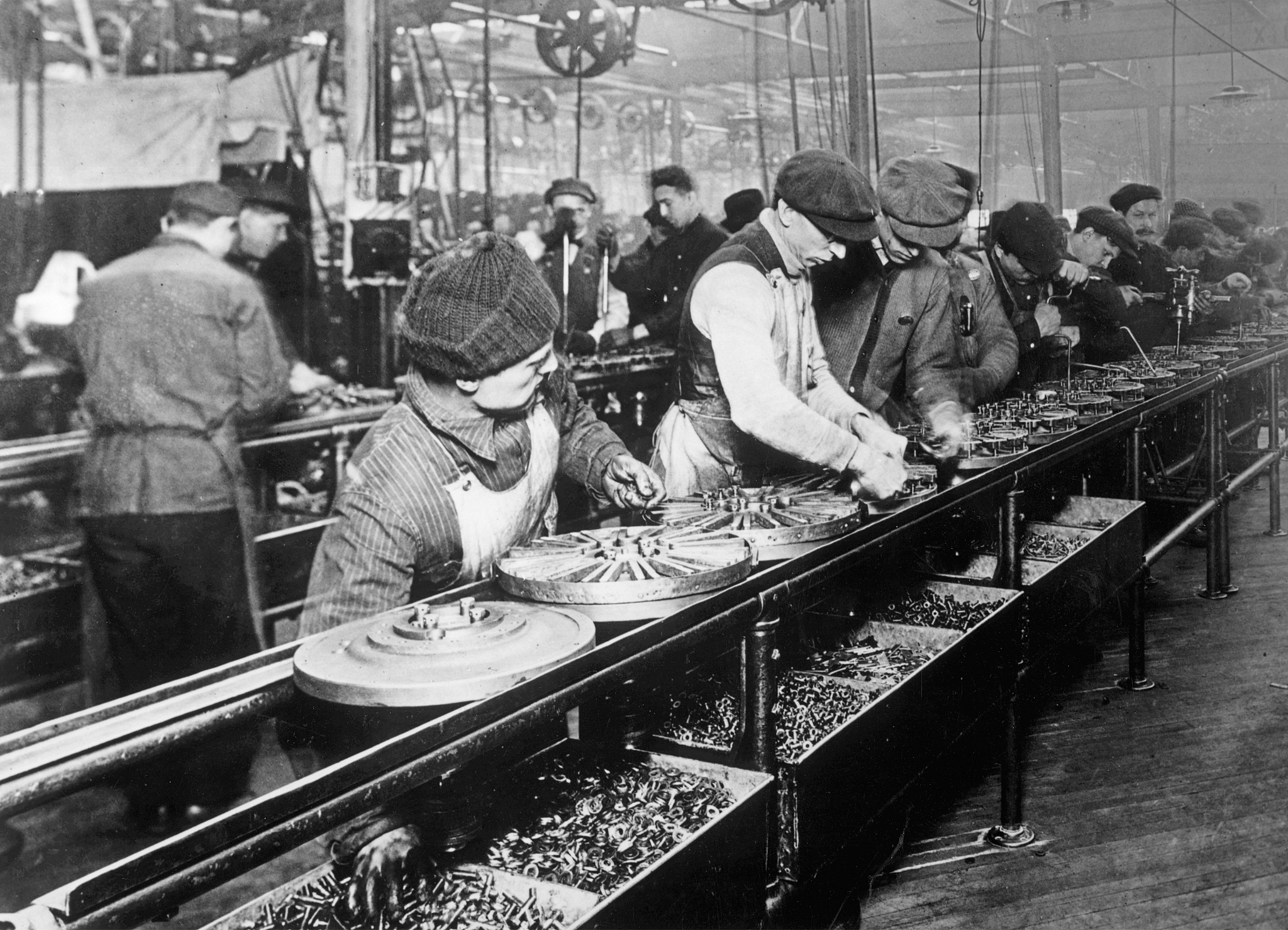
A very important and often underhighlighted factor in all of this is how the responsibilities and work changed as a result from the electrification. If we look at a very concrete example, the car factory as Henry Ford set it up. Before that moment, the skills of a car mechanic who manually was able to put a full car together was not needed anymore. The ones that were able to abstract out the work process and move up the chain kept their jobs (and even thrived). They moved to becoming industrial engineers who were able to think about the system they worked in, decompose the steps, reorder them in a way machines could do it, find and solve bottlenecks, oversee this supply chain, and basically fully re-architect the work on a meta level. The craftsman did not disappear, it moved up a level: he became an industrial engineer. The industrial engineers who had actually done the job manually were even more valuable as they could very critically oversee the quality level of the output and diagnose problems quickly.
.jpg)
In the end, the massive change in productivity and the massive leap forward did not come from the technology itself, but from a combination of economic factors, manufacturers figuring out how to use a technology optimally, and workers reimagining their jobs and the work process. By the time this was fully worked out, the technology they used was already almost 40-50 years old.
In this case, the substitution was not the useful layer, but layer two was basically redesigning the factory floor to a linear flow of production (the assembly line). The last layer and the emergence of a new paradigm followed the introduction of the industrial engineer. It was a way of working never imagined and it introduced jobs (and job titles) that had never existed before and would not have been possible before (like the industrial engineer). A second or third order effect of the electrification of the factory was creation of the mass-market consumer economy. The results caused a massive shift in society. It created the “middle-class”, the 40-hour workweek, marketing as we know it today and so much more.
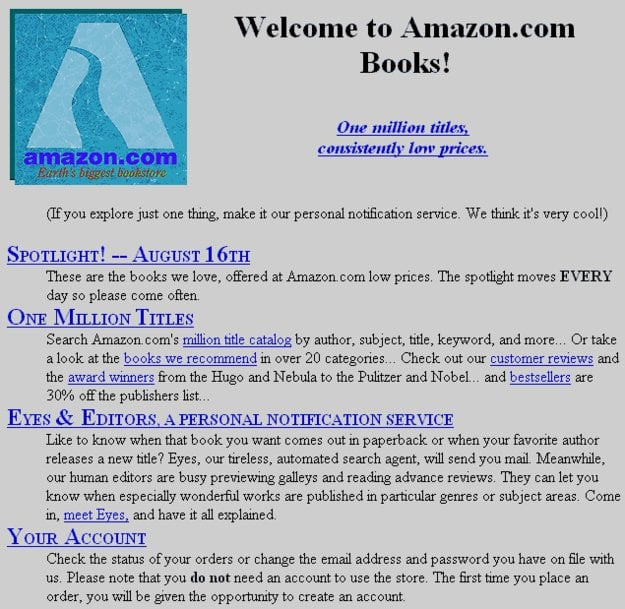
The timeline of these paradigm shifts is shortening with each new technology. If we look at the introduction of the internet, we basically went through layer 1 (substitution) around 1994. The substitution phase manifested itself in the form of a digital brochure (in 1994 the first ever secure online transaction took place where someone bought a Sting CD). Layer 2 (redesign) happened roughly between 2000-2010 where the first ecommerce businesses were redesigning the sales process (Amazon, Shopify, etc.). Layer 3 (emergence) happened from 2010 onwards where we got apps like Uber or Airbnb which would have never been possible without Layer 1 & 2. Next to that, who in the ‘90s would have thought a “social media manager” would be a job title? The internet paradigm shift played out in about 20-25 years instead of the 40-50 years it took for electricity to work out.
ChatGPT was only released on 30th of November 2022. It means that right now it has been little under 3.5 years since the introduction of this new technology in its current form. As discussed before, it was clear pretty quickly what the layer 1 applications would be (writing code, summarising texts, writing copy, etc.). We are already transitioning into the second layer, because we are reinventing the way people work in more sophisticated ways that were not even possible before.
Even personally, with the AI agency I cofounded (Latitude), over the past 12 months we have built a range of solutions that I would argue are in the overlap between layer 1 and layer 2. For example, we built a company-specific Audit AI Agent that uses the Dutch law, rules, standards, interpretations of the law and more to help a team of over 100 auditors save many hours a day. This was only possible by us understanding what’s possible with the technological overhang and matching that with the end goal of auditors. This allowed us to use LLMs in a way that goes beyond layer 1 (substitution) applications. The same goes for helping a real estate company scrape massive amounts of unstructured data to develop a view of the Dutch real estate market and identify opportunities before the rest of the market, or helping one the Netherland’s leading TV talkshows’ editorial board get an overview of what’s relevant to their target group before anyone else through processing massive amounts of data (socials, news, internal, etc.).
There are so many technological possibilities that are still in the first layer and we are only just entering the second layer of adoption. This is exactly why the concept of technological overhang is so important. We don’t need to wait for layer 3 to arrive, we need to figure out how we can start incorporating the technology today to fully utilise the value in layer 1 (substitution) and transition towards layer 2 (redesign).
Most companies today are still very much stuck in just getting a subscription to ChatGPT Enterprise, because they are the factory owners that have invested in a factory floor that is (for now) still working “just fine” with not enough incentive to change. They realise what is coming, but there is no urgency to reinvent their work.
What they don’t realise is that the Amazons (and potentially the Ubers) of the AI revolution will be founded in the coming years (or might already have been founded). The technological features are ready for us to make use of the technological overhang.
Right now it is time to realise that we are the craftsmen and car mechanics of the industrial revolution. How will the factory floor of knowledge work be reimagined into an assembly line, and how do you become the industrial engineer of your office job? Are you able to think about the system you work in, decompose the steps, reorder them in a way that AI can do it, find bottlenecks in it, oversee this whole chain, and basically fully re-architect your work on a meta level? If you do, you might be the Henry Ford of the AI age. Only once we have built that, can we start to find the answer to what the “social media manager” of the AI age will be…
Roughly analogous with Carlota Perez’s Techno-Economic Paradigm shift model.